Human-technology relations: the contractual case of the ‘closed loop’ insulin pump
Introduction
Since the American Philosopher Don Ihde (1934-2024) coined the term in 1995, postphenomenology has sought to move the philosophy of technology towards a deeper consideration of relations forged between humans and the technologies we use to shape our world—and how many, in turn, shape us.
Ihde aimed to augment the experiential focus of Pragmatism. While using some of traditional phenomenology’s analytical tools (e.g. variational theory and multistability) he moved toward an ‘organism-environment’—rather than a traditional ‘subject-object’—perspective, bringing a more inter-disciplinary approach to technology studies.
Idhe saw philosophy working alongside sociology and psychology in the analysis of ‘technologies in practice’, avoiding the ontological and epistemological cul-de-sacs that hampered traditional phenomenology.
Ihde’s ‘special move’ built on Hans Achterius’s empirically focused work in the philosophy of technology. He took a significant philosophical step away from the generalised consideration of technology as a discrete force ‘out-there’ towards the particulars of everyday technologies that are forged praxically in intimate relations with our bodies, minds, senses and interactions (Ihde 2006). Ihde’s framework still enriches the study of human-technology ‘co-constitution’ using four categories of relationship (we will come to these below).
My aim here is to bring Ihde’s thinking to life through a particular class of embodied medical technologies that use biofeedback loops to inform—and sometimes act upon—users.
CLIDs - a deep body, multi-modal technology
As a Type 1 diabetic, I have a Closed Loop Insulin Delivery system (hereafter CLID) that is a 24/7 attached ‘part of me’. It is a technology, fundamental to the control of my endocrine system, metabolism and ultimately my ability to both survive and function ‘normally’.
I aim to show that the complex nature of a CLID’s interactions with what Helena De Preester has called the ‘in-depth body’ (De Preester 2006) make it a multi-modal technology that calls for an extension of Ihde’s categorisation. I propose that a quasi-contractual relationship arises between CLIDs and diabetics who use them.
What do I mean by contractual? Simply that a diabetic must accept at the outset that this technology that becomes part of them also requires their compliance and their permission to allow it to shift modes of relation, exercise agency and change its intentional direction. These shifts are cued dynamically— and sometimes autonomously.
Ihde’s categories of technological relations
Surveying the rise of modern technologies, Ihde describes the rise of technoscience where technology aids and illuminates science, and vice versa. It is “the hybrid output of science and technology now bound into a compound unit” and he proposes that the postphenomenological approach is, in effect, a phenomenology of technics allowng us to “look at the spectrum and varieties of the human experience of technologies” (Idhe 2006). In Technology and the Lifeworld, Ihde illustrates these varieties describing a day that starts with a stream of activities and decisions, all mediated by technologies that are barely noticed so deeply are they woven and embedded in his lifeworld (Ihde 1990). In his Peking Lectures, Idhe sets out four categories of such relations:
- Embodiment relations which include bodily ‘extensions’ and technologies that are incorporated into—or onto—the body and may ‘withdraw, becoming transparent as we experience directly through them without even noticing.
- Hermeneutic relations where experience is mediated via the interpretation of say dials, gauges or other indicators. These relations are no longer analogous to everyday sensory experience as there is no direct experience of the phenomena that the technology reports on.
- Alterity relations where we relate to technologies as “quasi-objects or even quasi-others” []. These relations occur with technologies ranging from ATMs to humanoid robots where our interaction is with technology itself for its own sake.
- Background relations which remain in the perceptual periphery; present but unnoticed until attention is drawn to them or needed by them. Examples include the humming of an air conditioning fan or the flashing LED of an untriggered burglar alarm. (Ihde 2006)
Technologies may straddle two categories or move between them—for instance, the thermostat that functions imperceptibly in the background until hermeneutic interaction is prompted by cold weather (ibid).
Modern connected technologies present a more complex challenge. Rosenberger’s work on mobile phone interactions highlights their ability to ‘seize control’ over a user’s field of awareness during a call (or in modern times, Facetime) (Rosenberger 2006). Picture how smartphone users implicitly expect their mobile to span and move across categories. Modal shifts occur as we move between using the phone for calls, messages, games, alarms, video surveillance, movement tracking etc.—often with the phone itself or other parties (i.e. callers or text messagers) instigating the shifts. Importantly for this argument, new relationships don’t arise with each modal shift. We feel throughout that we are interacting with or through ‘our phone’ rather than with a current relational mode, be it embodied, hermeneutic, background or alterity. We accept (and expect!) that a smartphone functions multi-modally: ‘remote controls for life’. This indicates a special kind of intentionality that may direct ‘at’ anything that accepts remote interaction via GSM, Bluetooth or internet protocols.
By accepting that Ihde’s categories are more aptly applied to modes than to instances of human-technology relations, then deeper challenges for his account regarding modal intentionality and agency arise. This is most starkly illustrated by medical technologies that operate in deeply-incorporated—and occasionally autonomous—‘measure-respond’ biofeedback loops relations with those of us who rely on that.
Are these what Peter-Paul Verbeek calls ‘cyborg intentionality’? (Verbeek 2008). I don’t think so, but let’s examine the concept first.
Verbeek’s Cyborg Intentionality
Verbeek introduces ‘fusion technologies’ into the postphenomenological analysis of human-technology relations in order to overlay different categories of intentionality onto Ihde’s relational descriptions. He argues that Ihde’s categories represent a spectrum of distances from the body. Hearing aids and spectacles are close enough to be embodied relations but some background relations sit huge distances away from the bodies they relate to (i.e. satellites).
Fusion technologies such as neuro- and cochlear-implants sit much closer than the nearest end of Ihde’s spectrum. With these, actual bodily fusion takes place such that “no clear distinction can be made here between the human and the non-human elements” (ibid). Verbeek argues that this constitutes a cyborg relation which supercedes technologically mediated intentionality, creating a new ‘hybrid intentionality’ (Verbeek 2008). The deep fusion allows a new phenomenology where the fused hybrid can sample the external environment in novel ways. Rosenberger and Verbeek also introduce the concept of ‘bi-directional’ intentionality involving a reflexive interplay between human beings and technologies which ‘watch us as we watch them’ (Rosenberger/Verbeek 2015).
Adapting Ihde’s relational schematics, Verbeek supplements the dashes indicating relations and arrows intentionality with slashes (/) to indicate the fused basis of hybrid intentionality of, say, CI (see figure below) (Rosenberger/Verbeek 2015)

In biofeedback technologies, however, intentionality and sampling are not directed towards the external environment but towards the in-depth body world of the wearer. Putting two fingers on the radial pulse and counting is a biofeedback technique using our own technology! Biofeedback on the other hand measures phenomena from our inner world that are usually inaccessible otherwise.
Medical Biofeedback Technologies
The rise of wearable trackers or monitors of movement, heart rate, body temperature, ECG and other bodily metrics marks a clear development in incorporated technologies. Such devices monitor our activities and biomarkers of the body but usually withdraw until we review and interpret them. Some, however, people adopt so that they can move from transparency into hermeneutic warning or action states under certain conditions. People warned by cardiologists not to exceed certain threshold heart (HR) rates will wear HR trackers designed to interrupt them with audible and visual warnings if such thresholds are passed and to disrupt their behaviour. A hermeneutic imperative usurps the normally transparent embodied function of such technologies. There is no ‘breakdown’ in Heidegger’s sense: the technology itself has not broken or changed; rather, a modal shift has enacted a contract of cooperation and permissions that user and technology undertake at the outset. In blunt terms and in serious cases, the contract is ‘engage or risk dying’!
HR and activity watches are embodied technologies but they remain detachable. They are incorporated in the sense that we take a ‘technology, object or habit’ into our body image or schema. Meurice Merleau-Ponty’s examples of a feather in a cap and the blind person’s cane are low-tech examples of incorporation. The feather is pre-reflectively taken into account when navigating a doorway and the cane with time and experience becomes transparent for the blind person in its incorporation (Merleau-Ponty 1962).
Implantation takes this a large step further by incorporating technologies into the body. Ihde discusses stents, pacemakers and tooth crowns (Ihde 2019). However, new technologies such as multi-focal intraocular lens replacement and cochlear implants (hereafter CI) raise the bar of interactive fusion. Stents, pacemakers, implanted slow release drug capsules etc. are transparent and free of hermeneutic requirements unless they malfunction. Other technologies, however, shift modes depending on user or biofeedback inputs. A notable modern example is bladder control via Sacral Nerve Stimulation (SNS) where a permanently implanted device near the sacral nerve is controlled by an external device to facilitate urination.
CLID systems go even further interacting bi-directionally with the ‘in-depth body’—the sub-strata of endocranial and visceral functions that are not part of body image or body schema (indeed we have no awareness or knowledge of their existence or function except when they exercise a causal effect on our perceptible body) (De Preester 2006). When the in-depth body is disrupted this threatens homeostasis and may affect the entire body and brain’s ability to function.
Closed loop insulin systems
Without a functioning pancreas, humans cannot survive more than weeks at most. Insulin controls blood glucose levels (hereafter BG) metabolising consumed carbohydrate into enzymes that the body can use as energy. Thus, an unmedicated Type 1 diabetic (non-functioning pancreas) starves on a full diet; their BG rises unchecked causing weight loss, unquenchable thirst from osmotic failure, coma and eventually death. Type 1 diabetics require injected insulin therapy to manually control BG and metabolism.
CLIDs developed since 2010, form a system partially isomorphic to a ‘normal’ pancreas. A continuous blood glucose monitoring sensor (hereafter CGM) provides data to an insulin pump attached 24/7 that delivers insulin directly into the body using a cannula inserted 1cm into subcutaneous fat. The CGM is similarly inserted via a similar cannula, sampling glucose in interstitial fluids every two minutes. CGM data combines with carbohydrate information inputted manually to the pump by the user and together these generate and deliver an appropriate insulin response based on the pump’s computational model of human insulin therapy. The system seeks to maintain BG levels in an ‘acceptable’ range to prevent short term disruption to brain function caused by low blood sugar (hypoglycemia) and long term nerve and vascular damage from prolonged excessive blood sugar levels (hyperglycemia).
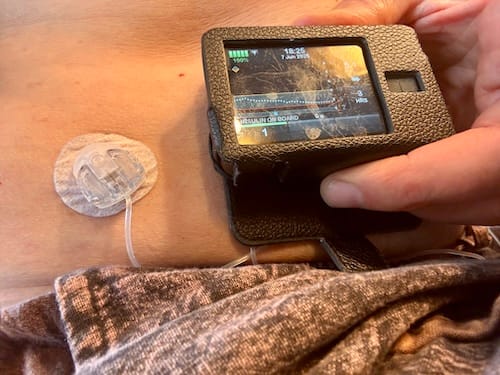
Closed loop systems are complex in their incorporation, interpretation and agency over the user. A CLID is an intimately embodied (but detachable) technology. It pierces the skin and enters the body but also includes an external device with an insulin reservoir and a screen displaying metabolic biomarkers such as BG, BG direction, insulin ‘on board’ (see photo 1). All are metrics accessible to non-users only via medical procedures. Some are for information only but others require—and occasionally demand—interpretation and action. Crucial to my argument, the combination of the pump’s computational model and the ‘contract’ the user makes with this technology allows it to control the endocrine system actively, and sometimes autonomously. This agency and intentionality is the foundation of the CLID’s ability to deliver homeostatic balance in the absence of a functioning pancreas. It controls the ‘in-depth’ body which in turn controls our facility for normal mental functioning, perception, cognition, motricity, mood, emotional regulation and ultimately survival. At times, a CLID prompts its host’s interaction; at others, it takes control in ways that they cannot override unless they tear the technology from themselves and discard it. Users are often not even conscious of these autonomous actions. My pump often takes over functions of my in-depth body without letting me know. In ‘user asleep’ mode, it is actively programmed to exercise agentic control without notification wherever possible.
The diabetic is also required to maintain the system’s needs: insulin reservoir refills, infusion point changes, battery recharges, cleaning etc. Unlike Heidegger’s broken hammer, a breakdown does not give a wearer the luxury of observing the ‘present-at-hand’ pump as a scientific object of scrutiny (Ihde 2006). Rather, within 30 minutes, the body and mind may begin to lose their usual facility—including the ability to interact with the broken system. This intimate and reciprocal link is again indicative of a mutually cooperative contract between system and user. After adoption, the fates of the two are conjoined and both must look after each other or both will cease to function.
The CLID ‘contract’ of agency and bodily ownership
Within a ‘normal’ BG range of 4.8mmol/l to 10mmol/l, human perception and cognition will—other things being equal—also be normal. Below BG levels of 4.5mmol/l, humans enter hypoglycemia. Excess insulin supplied by a CLID on account of say an inaccurate carbohydrate assessment, exercise (or a diet Coke served instead of a regular Coke!) metabolises the brain’s direct glucose supply into enzymes that it cannot use. This progressively and adversely affects the diabetic’s mood, perception and clarity of thought. As hypoglycemia deepens one may lose sensation in the legs or arms and become shambling, confused and disorientated. Perceptual fields lose coherence significantly below 3.8mmol/l and below 3mmol/l, one’s ability to resolve the visual field into differentiated objects may break down completely leaving hypoglycemic diabetics in a visual ‘mush’.
As the CGM detects any dangerous fall or rise in BG levels, it changes its mode and relationship with the user. It progressively, cumulatively and with increasing degrees of autonomy makes changes to the in-depth body (ie shutting off or boosting insulin delivery) and, when hypoglycemia is confirmed, attempts to solicit confirmatory interactions. The CLID will vibrate and beep periodic warnings that cannot be disabled. The diabetic must respond by pressing a pattern of touch screen keys to demonstrate their ability to coordinate their movement. They must also acknowledge that they are in danger and must consume carbs immediately (see photo 1). If the user complies and BG rises again above 5mmol/l, the tirade ceases; if not, the volume and repetition frequency of the beeps and warnings rises with the express intention of attracting the attention of others than the user.

Photo 1
The CLID can thus move independently between three of Ihde’s categories (embodied, hermeneutic, alterity). It may withdraw for long periods when BG is stable and in range. It remains hermeneutic allowing the wearer at a glance to read and interpret key metrics of metabolic function (see photo 2) but solicits no interaction. However, as in the example above, when BG drops or rises dangerously, its modes change and with them its phenomenology. In warning states, the CLID can feel scalding, angry and demanding to the user—petulant even. Finally, as it takes full autonomous control, it gains the alterity of a quasi-other, demanding first the attention and compliance of its wearer. If this is not sufficiently forthcoming, it shifts modes again and autonomously attempts to establish a hermeneutic relationship with others. Family or even public bystanders are solicited to interpret loud warning sounds, locate the pump, read its messages and even dial for an ambulance. This is not a fusion in Verbeek’s sense: the system establishes an ‘otherness’ and reaches out independent of its diabetic user.

Photo 2
CLID also presents challenges to De Preester’s analysis of the phenomenology of technological incorporation (that itself challenges Ihde’s classification where relative transparency is a distinguishing feature). She argues that the withdrawal of a much-used tool or the transparency of spectacles as they extend our sensory capabilities does not signify incorporation. Rather, she identifies incorporation with “bodily ownership” rather than the degree of prosthesis or implantations (De Preester 2011). With CLID, two 1cm subcutaneous cannulas are the extent of its tiny and temporary implantations, yet the bodily incorporation and phenomenology thereof is further reaching than most deeply implanted, “bodily owned” technology. The CLID measures what we can’t measure and acts as we can’t act to maintain homeostasis. Yet in its alterity modes it effectively separates itself entirely from body ownership, it becomes an externally directed alarm drawing attention to its stricken other.
Ihde’s examples of alterity include non-referential technologies such as toy robots that engage us in themselves, often for amusement. Here a deeper alterity is hard-wired into the CLID’s computational model and the attribution of bodily ownership when the system enters this mode is unclear and may be said to have changed completely with the mode shift.
Categorising CLID
Kirk Besmer’s insightful analysis of Cochlear Implants (CI) also challenges the applicability of Ihde’s categorisation where the quasi-restoration of a lost perceptual capability is made using a system that mixes fused and external technologies. With CI a unique ‘translation’ of auditory information occurs that requires months (sometimes years) of hermeneutic habituation to allow the user to near (but often never reach) the transparency of normal hearing. He thus concludes that CIs involve a “mix of embodied and hermeneutic relations but fully exemplifying neither…” (Besmer 2012). The same is true of CLIDs but the dramatic modal and phenomenological shifts they can make in response to biofeedback make a new categorisation necessary.
Unlike CI, CLIDs do not aid perception but underpin the biochemistry necessary for all perception, cognition and functioning. Also, unlike prostheses, IOLR, cochlear implants, pacemakers or bladder stimulators, CLIDs deliver an externally reservoired enzyme into the blood. They then sample the same blood to check the effect of this therapy.
The bidirectional nature of a technology that undertakes measurement/ infusion/control while retaining the agency to withdraw from the user, engage with them, or engage with other people in alterity mode deserves a new category.
Rosenberger and Verbeek note that by taking a postphenomenological first person perspective to human-technology relations we can study not their ‘separateness’ but their ‘distinction’. When technology takes an active mediating role in our relations with the world then “Agency… is not an exclusively human property anymore: it takes shape in complicated interactions between human and nonhuman entities”. (Rosenberger/Verbeek 2015)
Conclusion
Don Ihde’s four categories of human-technology relations offer a useful framework for analysis of human-technology relations. However, I have argued here that some medical devices that interact bi-directionally present a significant challenge to his original postphenomenological account of technology.
CLIDs blur—and move autonomously between—the dividing lines of embodied, hermeneutic and alterity relations in a way that are blurred particularly by CLIDs. They are an integrated technology that enters the body but remains largely external; they measure the biochemistry of the in-depth body and respond by administering a life-sustaining enzyme with or without prompting the user. Further, a CLID can (and will) exercise agency in moving out of transparent and withdrawn embodiment; through a quiet cooperatively hermeneutic mode; into a solicitously active hermeneutic mode; and finally into aggressively disembodied alterity directing itself intentionally and insistently towards the world its non-compliant diabetic user. (Ironically, in this stage, the user is not a ‘user’ but an ‘other’ that the system seeks to maintain while it takes control of soliciting external help).
This is how the CLID is designed, to act and respond to best protect its diabetic host.
I have argued that a new type of human-technology relation is thus in play; one perhaps best described as contractual. The multimodality and agency inherent in CLID operation require an agreement of mutual compliance in recognition that the human party is more likely to ‘fail’ than the technology party. The diabetic agrees to comply with and maintain the CLID but must also agree that she relinquishes both agency and control of her body to it in the event of non-compliance. With such devices, at any point both the technological and phenomenological relations with users may thus change dramatically and autonomously—but still in accordance with the implied contract of permitted behaviours. Philosophically CLIDs offers fertile ground to re-analyse classifications of intentionality, embodiment, incorporation and agency. While Ihde’s account remains useful, its classifications do not sit well with biofeedback technologies where relationships can shift dynamically.
BIBLIOGRAPHY
| Besmer, K. (2012) "Embodying a Translations Technology: The Cochlear Implant and Cybord Intentionality." Techné: Research in Philosophy and Technology 16 (3): p296-316 |
| De Preester, H. (2006). "In-depth body and the origins of the subjective perspective: representation or auto-constitution?" In 9th International Conference on Philosophy and Pscyhiatry, meeting abstracts (pp. 47–48). Leiden, Netherlands. |
| De Preester, H. (2011). "Technology and the Body: The (Im)Possibilities of Re-embodiment." Foundations of Science 17: pp.119-137 |
| Ihde, D. (2019). Medical Technics. University of Minnesota Press. |
| Ihde, D. (2009), Postphenomenology and Technoscience, The Peking University Lectures. Ch1 'What is Postphenomenology' Ch2 Technoscience and Post Phenomenology |
| Rosenberger, R (2013). "The Problem with Hands-Free Dashboard Cell Phones." Communications of the ACM 56 (4) pp38-40 |
| Rosenberger R and Verbeek P-P (2015) "A Field Guide to Postphenomenology", in Postphenomenological Investigations, Lexington Books, Eds Rosenberger and Verbeek. |
